The day you got promoted, the number that made you great stopped being your scoreboard.
Your team’s average is the scoreboard now.
Most sales managers get promoted because they were great at selling.
Then nobody teaches them how to lead.
If you’re a new manager, or you lead managers, that gap is the real problem.
After 25 years of building and leading sales teams, including one I scaled to 2,000 salespeople, I can tell you building a team isn’t hard. It’s misunderstood.
What I’ve learned over those years is what I now call Sellership®. I’ve packaged it into The Sellership System® to help you master the transition from selling to leading.
Here are the 3 things most sales managers miss. And at the end, I’ll show you exactly where to start your first 90 days.
1. Per Rep Average: measure what you multiplied, not what you produced
Here’s what nobody tells you when you get promoted. Your number doesn’t carry the heaviest weight anymore.
Yes, you will still need to produce, especially at first. Lead by example. Show the way. But what matters is what you multiplied, not what you personally produced.
Per Rep Average, or PRA, is the metric of effective leadership. A superstar can carry revenue. A superstar can’t carry the average. It only goes up when the whole team gets better.
So that’s your scoreboard now. Not your number. Not the top producer’s number either. Your team’s average.
Here’s what that looked like for me. I was the regional sales manager, and at the end of the summer we ran an extension program. I brought all of my managers in. My goal was every single person doing 50 or more home security sales within six weeks. It was unheard of. It had never been done before.
We all hit it. Our Per Rep Average was 60.
Here’s what I challenge you to do. Today, identify your team’s PRA. Find out where your team’s average really is right now, and write it down. Then at day 90, measure it again.
What matters is what you multiplied, not what you personally produced.
2. Mind-Heart-Feet™: know each person before you try to lead them
This is probably the simplest tool that will change everything as you apply it. Because most of us don’t know enough about the people we lead.
Mind is their goal. A specific, measurable goal. Not “do better.” An actual number.
Heart is what drives them to achieve that goal. It’s the real reason they show up to crush what they say they want. If they don’t want it badly enough, they won’t get themselves to take the kind of action it takes. The hands won’t reach for what the heart doesn’t long for.
Feet are the actions they take every day.
And here’s the key that took me a lot of years to learn. The mind and the heart control the feet. Always.
So when someone’s activity is off, don’t start with the feet. Don’t start with pressure, or a focus on their results. Look at the mind and the heart first.
Do they have a clear goal? Do they know why that goal matters to them? If they don’t know, that’s where you draw it out of them.
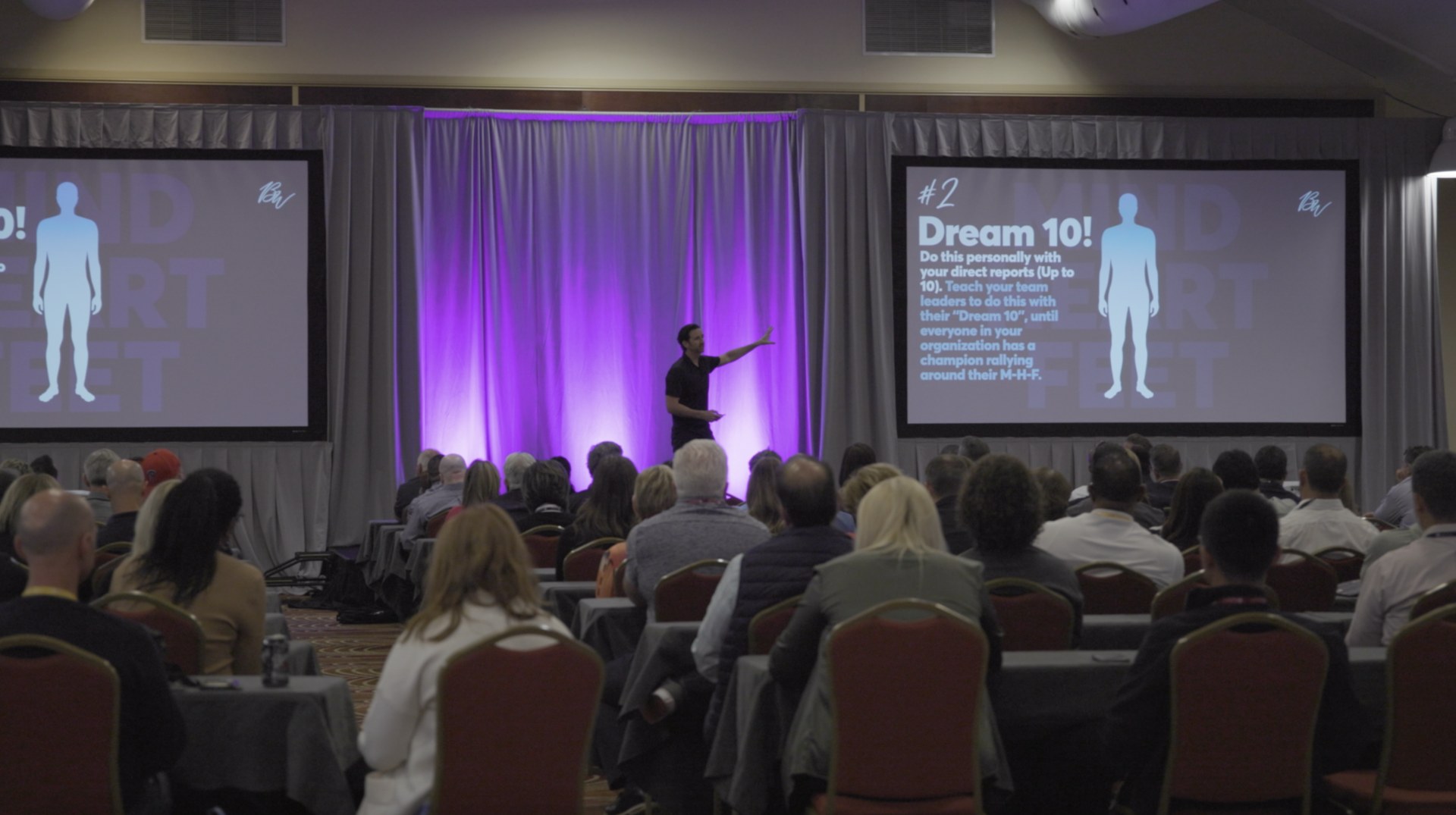
Here’s how to start. Write down the ten people you’re most responsible for developing. I call it your Dream 10™. Next to each name, write their Mind, their Heart and their Feet. Get crystal clear on what they want, their reasons, and why they want it. This will become your greatest advantage.
Do that this week.
If you want to put all of this into motion, I built a free 90 day plan for new sales managers. Download The First 90 (free).
3. Soft Like a Brick™: firm on the standard, soft on the person
You can get all the skills right as a leader and still fall short. You won’t gain the trust and respect of your team.
You want to be soft like a brick.
Soft means they need to know you care. Brick is your skill to have the hard conversations that raise the standard without lowering the person.
Here’s what to do. Set clear expectations, and then be firm on the standard. Soft on the person.
Most leaders pick one. They’re hard on everybody, or they’re nice and let everything slide. Neither one works.
Here’s the root of it. Never treat anyone in a way that makes them feel small. That doesn’t mean going easy. It means calling people higher than where they are right now.
So how do you see your people? As an obstacle, someone in your way? As a vehicle, someone who helps you get what you want? Or as irrelevant, someone you don’t even see? Any of those, and you’ll never lead them.
Now, sometimes they are just the wrong person. Before you decide it’s them, run 3 simple Checks on yourself as the leader.
- Expectations: Have I made the expectations crystal clear?
- Teaching: Have I taught them what good looks like and how to accomplish it?
- Correction: Have I corrected them along the way, candidly?
When you finally have the conversation, ask for their permission to challenge them. I call this the golden question: “Do I have your permission to challenge you?”
Then you can follow up with something like this: “I care about you too much to leave you where you’re at.”
That’s Soft Like a Brick.
Your next step
Here’s the short version.
Selling and leading are different skills, so measure yourself by your team, not just your own numbers, or the top producer’s numbers. Know each person: Mind, Heart, Feet. And become soft like a brick. Raise standards without lowering people.
If you want to know exactly what to do in your first 90 days as a sales manager, or you’re developing sales managers within your region, grab my free 90 day plan.
Watch the video: Building a Sales Team Isn’t Hard, It’s Misunderstood
Make it a great day.
Ben