People see a huge sales organization and assume the leader is stressed out of their mind, with more to do than they could ever get done.
I know, because that was me. Stressed out and overwhelmed. I had about 2,000 people, and I was trying to remember every rookie’s name. It was too much, and I was burned out to a crisp.
Here’s the lesson I learned the hard way. A leader can only lead about ten people really well at a time.
You’re not leading 2,000 people. You’re leading ten.
After 25 years of building and leading sales teams, the Dream 10 Roster™ is the first tool I recommend to any leader who wants to build and scale a high-performing team.
It’s one simple sheet that shows you who your key people are, what they want, and what your team is capable of producing.
Whether you lead 10 people or 100, this is where I’d start.
Here’s how it works, and how to build yours this week.
Lead ten who lead ten
The best leaders stop trying to reach everyone personally. They identify their ten. They become obsessed with their goals and fiercely responsive to each of them.
Then they teach those ten to do the same with their ten, all the way to the last person in the organization.
The goal is to get water to the end of the row.
Here’s the time split I teach. I call it 80/10/10.
- 80% of your time, energy and focus goes to your Dream 10, or to building, recruiting and developing your Dream 10.
- 10% goes to everyone else in your organization, for the escalated issues only you can really handle.
- 10% goes to administration, the things that have to get done and can’t be delegated.
Protect the 80%.
If you have 100 people, that 10% is spread across 90 of them. Directly, each one gets almost nothing from you. They’re still looked after, by the leaders you’re developing.
And if your team is smaller, the principle still applies. Invest your greatest energy in developing the people who will help you build what comes next.
To lead your ten that well, you have to see them clearly.
That’s what the roster is for.
Step 1. Get your whole team on one sheet
Most company dashboards are read only. You can see the numbers. You can’t move anything, and you can’t see the person behind them.
So too many of us leaders are just guessing.
Pull your people out of the dashboard and into a simple spreadsheet you control, one you can sort and change as your team changes.
Start with these columns:
- First and last name
- Day 1 (their start date)
- Years in sales
- Years leading
- Role
- Who recruited them
- Who they report to
- Social handle
Follow them on social. Pay attention to what matters to them, what they’re working toward, and what’s happening in their lives.
It’s another way to stay connected and understand the pulse of your team. But nothing replaces actually talking to your people.
That’s the minimum standard. Get it in place first.
Step 2. Identify your Dream 10
Here’s the exercise I walk leaders through.
Look at your whole sheet and ask yourself:
“If I could only keep one person, who would it be?”
Put them at the top.
Now the two of you get to bring one more. Who is it?
Keep going until you have ten.
These aren’t always your top producers. They’re the people who have your back. The people you’d build a dynasty with.
Don’t get stuck on the number. It can be 7. It can be 12. And it changes.
This is your inner circle, and it lives at the top of your sheet.
Now comes the part that makes the roster so valuable.
Step 3. Know their Mind-Heart-Feet™
Most leaders don’t know their people as well as they think.
I was coaching a regional manager, and I asked him what one of the guys on his Dream 10 was going for this year.
He said, “Somewhere between $150,000 and $250,000.”
That’s a $100,000 gap.
I said, “What I just heard you say is you don’t know what he’s pushing for. Is that right?”
He laughed and said, “Yeah, that’s right.”
So I challenged him. He didn’t know enough about his guy to lead him effectively.
Vague targets get vague results.
For each of your ten, you need three things, specific enough to write down:
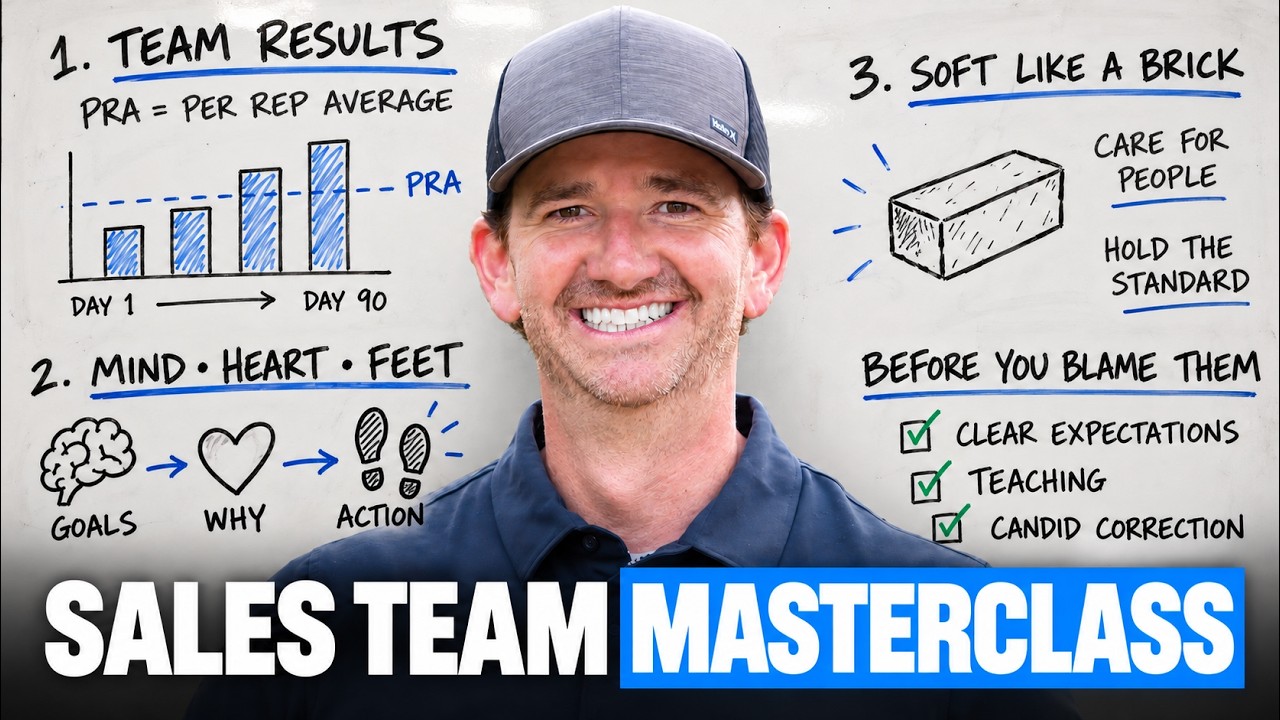
- Mind. What’s their specific goal? Usually a personal revenue target, anchored to something in their control.
- Heart. Why does it matter to them? The house. The freedom. The family.
- Feet. What are they actually doing about it right now?
If someone has a feet problem, it’s almost always a mind or heart problem.
So have the conversation.
Ask them straight:
“What’s your number this year?”
“Why does that number matter to you?”
“What are you doing this week to get there?”
Listen. Write it down.
When it’s on the roster, you can see what matters most to each of them at a glance. You can see where their actions line up with their goals and where they don’t.
And you can lead them for their reasons, not yours.
That’s your number one job as a leader: help your leaders actually get what they want.
Step 4. Add their numbers and your Blink
Next to each person, put two numbers:
- Their revenue goal.
- What they’ll actually earn when they hit it. This is where it gets real for them.
Use those two numbers in your conversations to get them fired up.
Then add what you’ll earn as their leader when they hit it. That one is for your planning only. It stays on your sheet, and you never show it to the people you lead.
Now, managers tell me, “Ben, you never really know what they’re going to do.”
I hear you. But you can get closer than you think.
So add one more column. It’s called your Blink.
Malcolm Gladwell wrote a book called Blink about the snap judgment you make in the blink of an eye. Most of the time, your blink serves you well. Not always, but most of the time.
On the roster, your Blink is your gut read on what each person will actually do, based on everything you know about them.
Their goal stays their goal. Your Blink sits right next to it.
Say one of your leaders has a goal of $3 million. That goes in the goal column.
Next to it, you write your Blink. Based on what you know today, maybe you think they’ll do about $2 million.
Do that for all ten. Then add it up.
Here’s where the Blink becomes more than a projection. It becomes a coaching tool.
Use your Blink numbers to plan. Then get to work growing and developing your people.
When there’s a gap between someone’s goal and your projection, that tells you where to focus.
You can sit down with that leader and say:
“Hey, listen, you’re not doing what it takes to hit three million. Here’s what you need to do to get there.”
Now you’re coaching toward their goal, using what you know about their current actions and performance.
Your Blink isn’t a ceiling on what they can accomplish. It’s your current projection and a way to identify where development is needed.
As your people grow and their actions change, your projections can change too.
Walk into your VP’s office with a plan
Once you’ve built your roster and added up your projections, you have a much clearer picture of what your region is likely to produce and what you’re likely to earn.
You have something to plan around. Clarity is a superpower, my friend.
And here’s the part most managers miss.
That number is leverage.
Take it to your leader, your VP, your owner, and ask for the support and funding to actually hit it.
Walk in with a plan:
“Here’s what we’re going to do. Here’s who’s going to get us there. Here’s what I need to make it happen.”
That’s when they lean in.
And that’s when you stop being the manager who hopes and start being the leader who plans.
What it looks like in a one-on-one
I prepped every one-on-one from the roster.
Before the meeting, I looked at their row. Their goal. Their why. What they’re doing. Where the gap is.
Then the conversation sounded like this:
“You told me this matters to you. Let’s look at whether your actions are getting you there.”
Then I taught my Dream 10 to build their own, and their ten built theirs.
That’s how you lead 2,000 people without talking to 2,000 people.
Not every rep had me. But every rep had a champion.
Build yours this week
The guide and template are free, so you’re not starting from a blank sheet:
Get the Dream 10 Roster Guide and Template
Start with your team. Identify your ten. Fill in what you know, and have the conversations to learn what you don’t.
Then use it in your very next one-on-one.
I walk through the whole thing, column by column, in the video:
Make it a great day 👊🏼